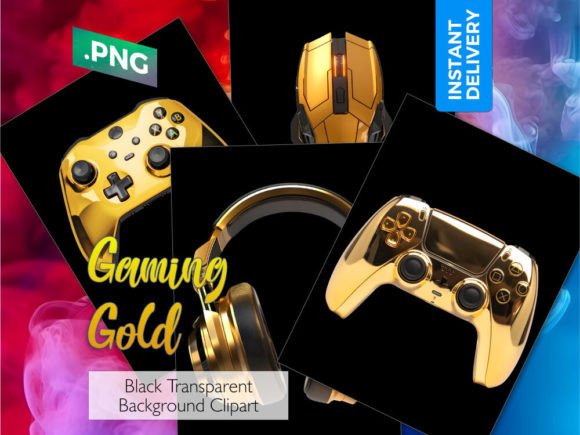
Gaming Gold Sublimation PNG Clipart: A Practical Resource for Small-Scale Production
If you create custom merchandise, design printable products, or run a small print-on-demand operation, you know that sourcing reliable digital assets is rarely straightforward. Many graphics look promising in preview but fail under real production conditions—poor resolution, awkward dimensions, or incompatible formats. The Gaming Gold Sublimation PNG Clipart collection aims to solve that problem for anyone working with gaming-themed designs on smaller items. This set offers five customizable PNG elements with transparent backgrounds, built specifically for sublimation printing and digital card creation. But what does that actually mean for your workflow and final output? Let's examine the collection closely.
What the Gaming Gold Sublimation PNG Clipart Offers
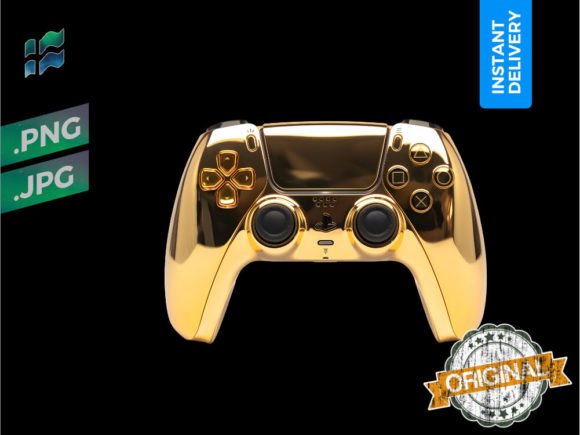
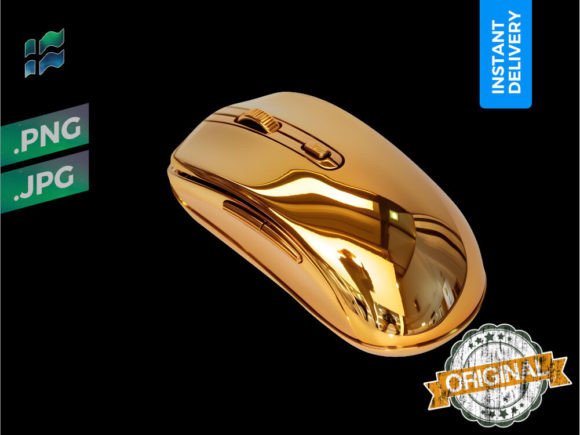
The collection includes five distinct gold-toned gaming elements, each provided as a standalone PNG file with a transparent background. Every element is rendered at 1800 by 1200 pixels with a resolution of 300 dots per inch. These specifications are not arbitrary—they align directly with standard card sizes and small-format sublimation blanks. The assets are designed to fit a 7 by 5 inch canvas without requiring scaling, which means you can place them directly into your layout software and proceed to production with minimal adjustment.
Because the files use transparent backgrounds, you can layer them over other designs, patterns, or solid substrates without having to erase or mask around unwanted edges. This is particularly useful when combining elements from different sources or when integrating text, borders, or additional graphics around the gaming motifs. The gold color scheme gives the set a cohesive visual identity, which simplifies the design process when you want a unified look across a product line.
Resolution and Print Intent Are Well Defined
One of the most common frustrations with clipart bundles is ambiguity about size limits. These files are intentionally spec'd for small-scale items—cards, stickers, tags, and sublimation blanks that fall within the 7 by 5 inch range. At 300 DPI and 1800 by 1200 pixels, the resolution is appropriate for sharp reproduction at that scale. If you insert the image into a template at full size, you will not see jagged edges or blurry details when printed. The gold tones carry a metallic look that translates well onto glossy or coated substrates, provided your sublimation paper and ink are calibrated correctly.
Transparent Backgrounds Reduce Prep Time
For a designer or small business owner, time spent on cleanup and masking is time not spent on layout, proofing, or fulfillment. Because each element ships with an alpha channel already intact, you can drop the PNG directly onto a colored background, a pattern, or a preprinted card base and have it look clean immediately. This is especially valuable if you are producing multiple variations of a product and need to swap elements quickly without redoing masking work each time.
Consistency Across the Set
All five elements share a similar gold palette and rendering style, so they feel like parts of the same visual system rather than mismatched pieces pulled from different sources. If you use two or more of them together on a single card or sublimation panel, the overall composition remains coherent. This kind of consistency is harder to find than many clipart listings suggest, and it reduces the risk of a final product looking disjointed.
Who Benefits Most from This Clipart
The Gaming Gold Sublimation PNG Clipart is best suited for creators who focus on small-format gaming-themed merchandise. If you produce birthday cards, thank-you notes, stickers, magnet sets, keychain inserts, or coaster sublimation blanks for a gaming audience, these elements fit naturally into that workflow. Freelance designers who take on custom card orders for esports events, game store promotions, or gaming community meetups will also find the set useful for maintaining a polished gold aesthetic without starting from scratch each time.
Small business owners operating on platforms like Etsy, Amazon Handmade, or local craft fairs can use these assets to build a consistent product line. Because the resolution is tuned for small prints, you can produce multiple units from one file without worrying about detail loss at typical production scales. The fact that the collection includes five distinct elements also gives you flexibility—you can use one per product, combine several on a single design, or rotate them across different items to create variety while keeping a cohesive brand look.
Educators or organizers creating gaming-themed certificates, award cards, or participant badges may also find these assets practical. The gold coloring works naturally for achievement-oriented materials, and the transparent background lets you place the graphic over a custom background design that includes event names, logos, or dates.
Realistic Limitations to Consider
No digital asset is a universal solution, and this collection has specific boundaries worth noting. The most important limitation is the size constraint. These images are explicitly not designed for wall art, large posters, or banner printing. Enlarging them beyond the intended 7 by 5 inch canvas will cause noticeable pixelation, especially around any fine edges or gradient transitions in the gold rendering. If your project requires large-format output, these files are not the right starting point.
Additionally, the set includes only five elements. For someone building an extensive catalog with many distinct designs, five assets may feel limited. You can certainly combine them with other graphics or rotate usage across products, but if you need a high volume of unique motifs, you may need to supplement this collection with additional sources or create your own variations.
The gold color palette, while cohesive, may not suit every brand or project. If your gaming-themed line uses neon accents, dark metallic tones, or full-color character art, the gold-only scheme could clash or feel too narrow. It works best when gold is already part of your intended color story or when you want a celebratory, premium, or achievement-oriented feel.
Finally, because these are raster PNG files, scaling down is safe, but scaling up is not. You also cannot edit the individual elements as vector paths. If you need to reshape part of a design, change a gold tone to silver, or extract a sub-element, you will need to work within Photoshop or a similar raster editor, and the results will be limited by the original pixel data.
How These Assets Perform in a Typical Workflow
In a standard production run—say, a batch of 50 gaming-themed thank-you cards for a local game store—the process is straightforward. You open your template at 7 by 5 inches at 300 DPI, drag in the PNG element, position it, and add your text or border. Because the background is already transparent, you can place the graphic over a dark card base or a patterned background without halos or edge artifacts. The gold rendering prints cleanly on compatible sublimation paper, and the resulting transfer adheres well to polyester-coated cardstock or similar blanks.
If you are producing stickers, the same file works directly in a cut file setup. The 1800 by 1200 pixel canvas gives you room to add a small white border around the graphic for kiss-cut or clear sticker production. Just be mindful of the DPI—if your sticker template is smaller than 7 by 5 inches, you can reduce the image size without quality loss, but avoid enlarging it.
Practical Recommendations
Before purchasing, review your typical product sizes. If you regularly print on 4 by 6 inch cards, 3 by 3 inch stickers, or 2 by 3 inch sublimation tags, this set is a strong match. If your primary products are 11 by 17 inch posters or large-format mouse pads, look for vector-based assets or higher-resolution raster files designed for those dimensions.
Consider the color profile of your production workflow. The gold tones in these files are rendered in RGB, which is standard for digital design. If your sublimation printer uses a specific ICC profile, you may want to test a sample print first to confirm the gold renders as expected on your substrate. Slight shifts in hue or saturation can occur depending on the paper, ink, and temperature settings.
If you find the set of five elements useful but want more variety, treat these as anchor pieces for a larger collection. Build a template library around them, add your own vector accents or typography, and rotate usage across product lines. This approach stretches the value of the assets without requiring you to buy multiple similar bundles.
Long-Term Value for Creators
The durability of any clipart collection depends on how well it integrates into your ongoing production. Because these files are resolution-specific to a common print size, they will remain useful as long as you continue creating small-format gaming merchandise. The gold aesthetic does not follow seasonal design trends closely, which means the assets are unlikely to look dated after a few months. The transparent background format is a standard that will be compatible with design software for the foreseeable future, so you will not face format obsolescence issues.
For a freelancer or small business owner who values efficiency, the reduction in prep time and the elimination of background removal tasks can add up significantly over dozens or hundreds of orders. The five elements may not represent a huge library, but they serve a specific purpose well, and that focus is often more useful than a large bundle of mismatched files.
Ultimately, the Gaming Gold Sublimation PNG Clipart delivers exactly what it promises: a small, consistent set of gold-toned gaming graphics ready for small-format sublimation and card production. It is not a one-size-fits-all solution, but for creators working within its intended size and style range, it offers a practical, time-saving resource that performs reliably in real production conditions.